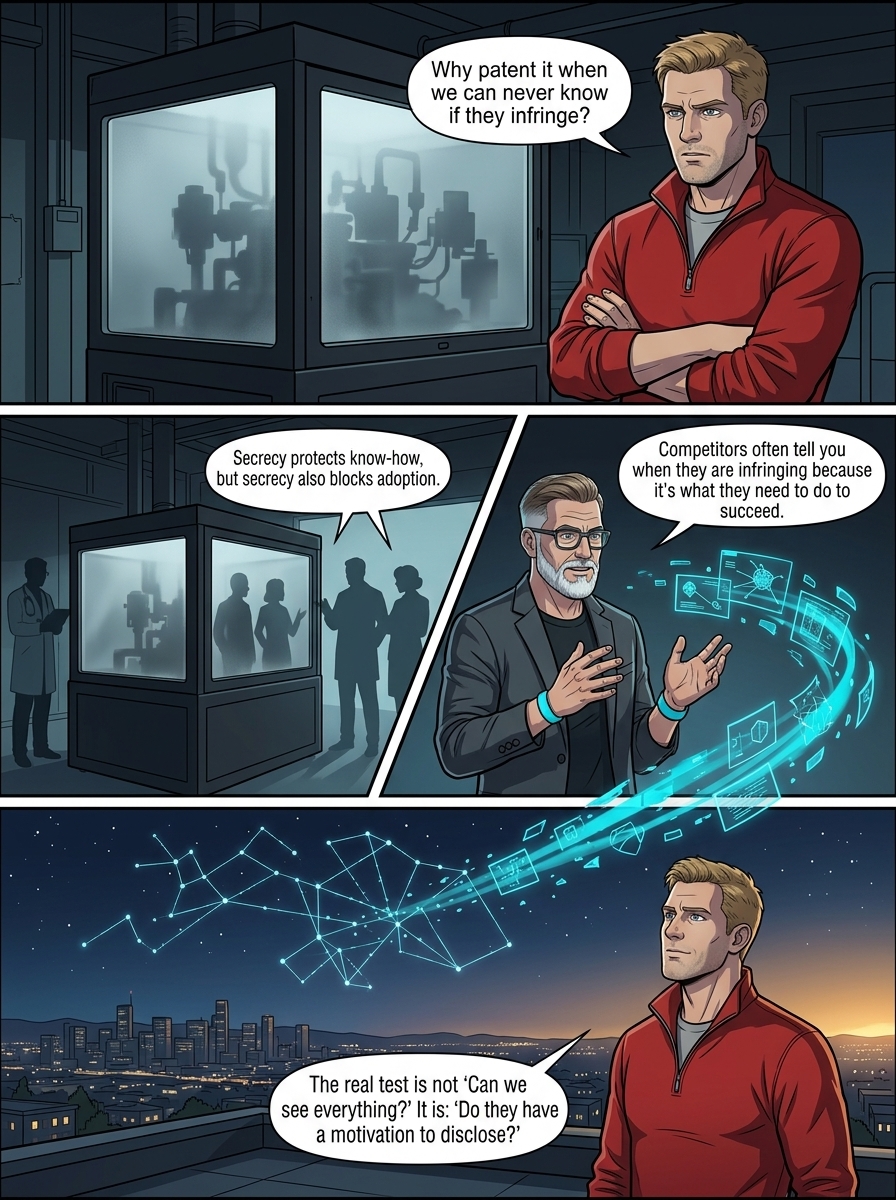
Founders often say: “We should not patent this because we would never know if someone infringed it.”
Sometimes they are right. If patenting would reveal core know-how and a competitor could run the method without leaving any meaningful public trail, trade secret protection may be the better answer.
But “we could never tell” is not a conclusion. It is an untested assumption about how the competitor’s business will actually work.
The Real Question Is About the Business, Not the Process
The real question is not whether the method is visible from outside the competitor’s business. It is whether a competitor is likely to sell it, validate it, raise money on it, support it, and earn trust from customers, regulators, investors, and partners without explaining enough of the method to matter.
Many companies don’t disclose because they slipped up. They disclose because disclosure helps them win. Physicians need validation before ordering a diagnostic. Lab customers need protocols before adopting a sample-prep workflow. Researchers need workflow diagrams before trusting a spatial transcriptomics platform. Developers need documentation before building on an API. Investors, partners, recruits, regulators, and payers need enough technical specificity to believe the system works. Some disclosure is voluntary because it sells, validates, recruits, raises money, and creates technical legitimacy. Some disclosure is effectively mandatory, because the market, regulators, the reimbursement system, or the customer-support burden will not accept a black box.
Companies are often motivated to create the evidence trail. Sometimes they are forced to.
The Evidence Trail Comes From the Competitor’s Own Words
Patent enforcement does not always require a camera inside the factory. A company’s own technical statements can produce the evidence: product documentation, validation papers, technical protocols, conference presentations, regulatory materials, developer guides, model cards, and white papers can all become evidence when they connect the accused activity to the claims. They create the public record that says something concrete about the workflow: the steps performed, the inputs used, the outputs generated, or the way customers are instructed to run the system.
For many method claims, the patent owner is not trying to prove it watched each step inside the competitor’s facility. It may be enough to show that the product is designed to operate in the claimed way, that ordinary use performs the claimed steps, or that the company instructed customers or developers to use the system in a way that performs them. In some process-patent settings, federal law adds a burden-shifting framework: under 35 U.S.C. § 295, where the patent owner shows a substantial likelihood that a product was made by the patented process and that it made reasonable efforts to determine the actual process and could not, the product may be presumed to have been made by that process. It is a narrow provision, but it exists.
Consider diagnostics. A transplant or oncology diagnostic is performed inside a lab. A competitor could run the assay in its internal lab, locked away from prying eyes. But a serious clinical diagnostic cannot be commercialized on a “trust us” basis. The company wants physicians, payers, regulators, partners, and acquirers to believe the test, and that requires validation data, method explanation, clinical utility arguments, conference presentations, and often regulatory or reimbursement materials. The disclosure is not accidental. It is how a lab method becomes a reimbursable, adopted product. That body of public validation and product material is exactly the kind of record that can turn an invisible lab workflow into an evidentiary trail.
Sample-prep and platform-method cases make the same point. Microfluidics and spatial transcriptomics workflows are not consumer features you inspect by wearing a watch. The commercially important action happens in reagents, instruments, protocols, and data workflows. But platform companies want customers to adopt the workflow, reproduce it, cite it, build on it, and train others to use it, and that requires user manuals, technical notes, workflow diagrams, application notes, and publications. And a business need to teach complex research platforms can create the kind of public technical record a patent owner can evaluate. The company is not confessing. It is doing what successful platform companies do.
The AI/ML version is newer, so it should not be oversold as a mature enforcement playbook. Still, the same disclosure pressure is already visible. A company using AI to design DNA, RNA, or protein sequences may keep model weights, training data, ranking logic, and design heuristics secret. But if it wants partners, investors, regulators, collaborators, or customers to trust the platform, it has reasons to publish model architecture, benchmark results, validation workflows, generated-sequence examples, wet-lab confirmation, or design constraints. Opacity protects know-how; too much opacity blocks adoption. Public launches of biological language models illustrate the pattern: the platform does not disclose everything, but it discloses enough about model behavior, inputs, outputs, and validation to be credible.
When Trade Secrets Still Win
None of this means every hidden process should be patented.
Some methods really are hard to detect. A semiconductor fabrication recipe may run entirely inside a cleanroom and leave no signature in the finished chip. A server-side ranking model may operate behind an API without revealing its weights, thresholds, or training data. A manufacturing improvement may cut cost without changing the finished product in any detectable way. A generative biology model may produce useful sequences while keeping its training corpus and selection logic opaque. Those inventions may be better protected as trade secrets, especially where patenting would teach competitors what they cannot otherwise observe.
Four Questions, In Order
So the answer is not “always patent.” It is to run four questions in order.
First, is the invention commercially important enough to protect at all?
Second, if a competitor used it, would that competitor want or need to reveal enough of the method to detect and prove use? Run an evidence-trail audit. Identify the channels a competitor would likely use: clinical validation papers, protocols, user manuals, API documentation, model cards, regulatory filings, reimbursement submissions, investor decks, conference talks, S-1 filings, technical blogs, and public code repositories. If selling, validating, raising money, recruiting, obtaining reimbursement, supporting customers, or satisfying regulators pushes the method into two or three of those channels, it is less hidden than it feels.
Third, can the claims be drafted around the parts of the invention the market will pull into the open? If the hidden process produces an observable product characteristic, claim the characteristic and the process that creates it. If the method must be validated in the literature, draft with that record in mind. If the workflow must be taught in manuals, claim the steps those manuals will describe. If the model must be published to gain credibility, consider claims that track the architecture, input-output constraints, validation loop, or wet-lab confirmation the company will have to explain.
Fourth, does the value math close on the right clock? Confirm that a detectable, well-drafted patent would at minimum spare the company a diligence haircut and, ideally, be credible enough to an acquirer’s counsel to add to price. Confirm the evidence trail is likely to appear early enough in the current owners’ hold that a buyer prices it near full value. Confirm the near-term filing spend is small against the probability-weighted delta in exit value, with the low-probability enforcement tail accounted for. If those hold, the filing is not a litigation bet. It is a cheap, near-term purchase of a contingent right that, weighted for the odds, still clears its cost, and that shows up in the acquisition price. If they do not, do not file, and spend the money on secrecy and speed instead.
A Layered Strategy
The patent need not disclose every operational detail. A layered strategy patents the commercially important behavior competitors will have to reveal, and keeps implementation details, process parameters, datasets, manufacturing refinements, model weights, and ranking logic as trade secrets where secrecy has real value.
For a founder or an investor, “we could never detect infringement” should not be a reflexive veto. It should be a drafting constraint, a budgeting question, and a timing question.
The real test is not “Can we see everything?” It is: “Will they show enough?”