The United States Patent and Trademark Office offers two reduced-fee categories. Small entity status cuts most patent-related fees by 60%, while micro entity status cuts them by 80%. The discounts apply through filing, examination, issue, appeal, and maintenance. They can make a big difference for companies just starting up. Paying the lower rate is also a legal representation that the party paying the fee qualifies for it.
Here’s the problem: a false claim for a reduced patent fee can put a patent’s enforceability at risk.
Ole Nilssen’s case shows how a fee decision can become a patent-enforcement disaster. Nilssen, an inventor with more than 200 lighting patents, signed agreements giving Philips rights under many of those patents and, even though Philips had more than 500 employees, kept paying reduced fees. A license to a company that size ends the discount. Treating the fee payments as part of a broader record of misconduct, a trial court in his suit against Osram Sylvania refused to enforce 15 patents.
The trial court found more than $200,000 in underpayments in the Philips-licensed portion of Nilssen’s portfolio. In that case, Nilssen sought more than $100 million in damages. He left with 15 unenforceable patents and an order to pay Osram more than $5 million in attorneys’ fees and more than $300,000 in costs. The underpayments became the smallest number in a very expensive case.
The problem often begins with a short email from patent counsel: Do we qualify for the reduced rate? If the company says yes, the attorney pays the lower fee. The company must determine small-entity eligibility before first claiming the discount, before paying the fee to obtain an issued patent, and before each maintenance-fee payment. Micro entity status requires a fresh check before every fee. One unexamined rights deal can make an inaccurate determination recur across a patent family.
The stakes behind those checks are now statutory. When the USPTO assesses a fine for a false entity claim, the fine is at least three times the underpayment. A good-faith error escapes the fine, and good faith turns on inquiry: what would a reasonable check of the rules and the rights agreements have revealed before the claim was made? That is the practical should-have-known problem. Before claiming a reduced rate, the USPTO tells applicants to review the rules and the facts needed to confirm eligibility, then keep records of the steps taken for each application. The records are how a company shows the inquiry happened. The fine runs on one track. Whether a false claim also threatens the patent itself runs on a second track, in district court, where the question is not diligence but intent to deceive. Nilssen lived on the second track.
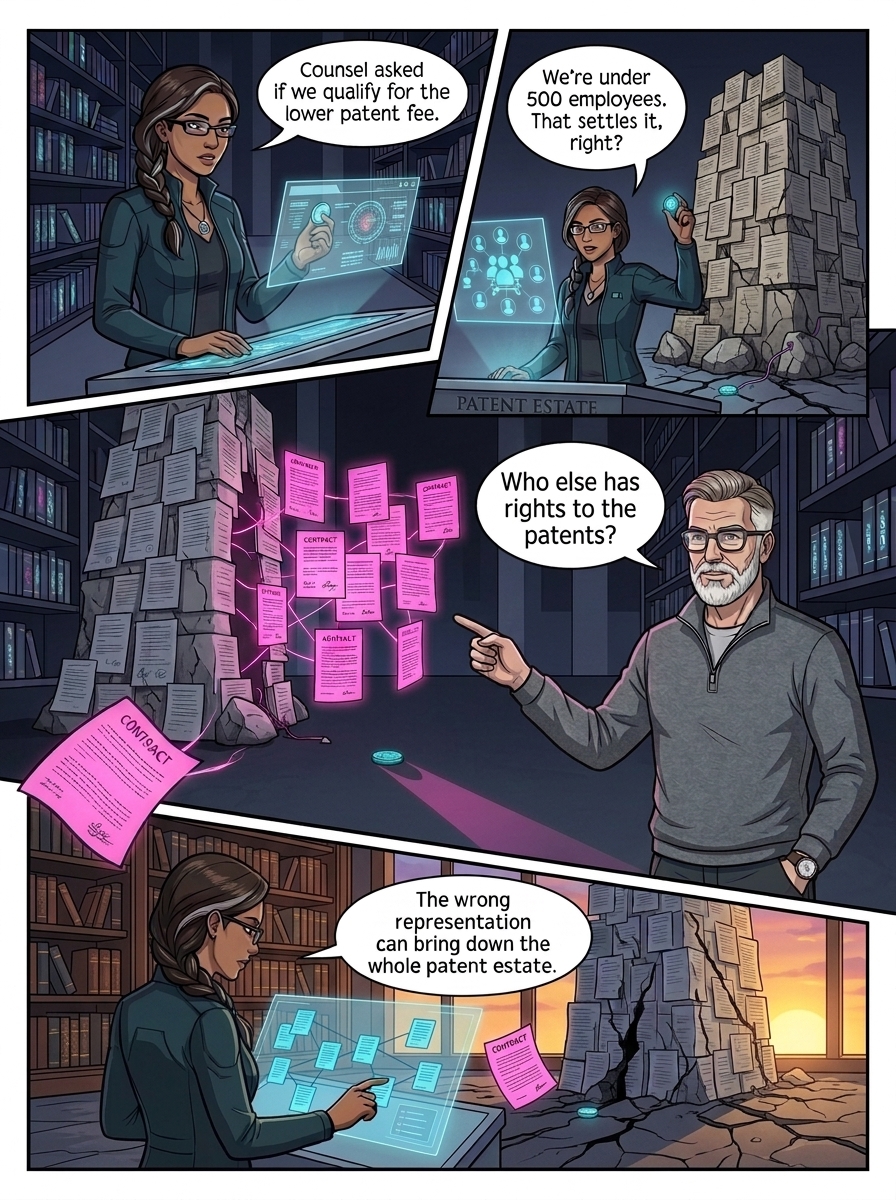
A party seeking the small-entity discount must be an individual, a qualifying small business, or a nonprofit organization. A business generally must have no more than 500 employees, including affiliates. The threshold is the beginning of the inquiry, not the end. The company must also identify every outside organization that holds patent rights or has a contractual right to receive them, and each organization must qualify for the discount, because rights in the hands of a party that does not qualify generally end the company’s eligibility.
The USPTO treats the right to stop others from making, using, selling, offering to sell, or importing an invention as a patent right. A license can matter even when more than one company can use the technology or the licensee pays no royalties. An option agreement can change eligibility even before exercise of the option when the agreement obligates the company to grant or license rights to an organization that does not qualify. The label “option” does not decide the question. The obligation does.
Financing side letters, university agreements, strategic licenses, investor rights, and creditor defaults can move patent rights without changing headcount. If the recipient does not qualify for the discount, the company may lose the discount. Patent counsel cannot evaluate agreements it does not receive. The immediate shortfall may be small. The larger question is who held the relevant rights when the company paid the reduced rate.
Micro entity status adds a separate set of facts. The income-based route begins with small-entity eligibility and requires current information about applicant and inventor income, earlier U.S. patent filings, and rights given to higher-income organizations. The route generally permits the applicant and each inventor no more than four earlier U.S. patent filings, subject to exceptions. Continuations and divisionals count toward the limit, and so do international (PCT) applications for which the U.S. basic national fee was paid. Provisional applications, foreign applications, and certain applications tied to a prior employer do not count. As of July 30, 2026, the USPTO lists $251,190 as the maximum qualifying gross income. A company that qualifies for small entity status may still fail the micro-entity test.
Nilssen bore responsibility for the fee assertions. Philips’s position as a licensee points to a separate business lesson for a sophisticated counterparty: when a company receives patent rights, ordinary diligence should compare the rights agreement with the fee status claimed for the same patents, because a false fee statement by the licensor can leave the licensee holding rights to patents no court will enforce. A licensee should repeat that review before relying on the patents. Nilssen shows how expensive the failure can become.
Nilssen Shows the Difference Between a Fee Error and Deception
Nilssen did not become ineligible because his own business grew past 500 employees. Philips had more than 500 employees, and the agreements between Nilssen and Philips caused the issue. The trial court found at least 27 improper USPTO payments and 15 signed statements claiming small-entity status. Nilssen had personally handled more than 1,000 patent applications. The court did not accept Nilssen’s claim that he had misunderstood the rule.
Fee payments were only one part of the Nilssen case. The trial court also found misleading affidavits, improper claims to an earlier filing date, and undisclosed related litigation and earlier technology. The appeals court upheld the refusal to enforce 15 patents. Nilssen was decided before a 2011 ruling by the federal appeals court that hears patent appeals adopted a tighter test for deception in the Patent Office.
Under the current test, a challenger normally must prove by clear and convincing evidence that the person who claimed the discount specifically intended to deceive the USPTO. The challenger normally must also show that the misstatement mattered to whether the USPTO allowed the patent claim. Courts have questioned how that second requirement applies to a fee-only error because the error changes the fee but not patentability.
The tighter test raised the challenger’s burden. It did not retire the theory. The USPTO itself notes that accused infringers still argue false fee status as a basis for inequitable conduct, and a record like Nilssen’s, repeated signed statements from an experienced filer whose explanations the court rejected, is the kind of record a challenger uses to argue intent.
On the administrative track, the USPTO gives a good-faith fee error a defined cure. A record of reasonable inquiry supports the good-faith explanation needed for that correction. An intentional falsehood raises a different and stricter question: whether a challenger can prove specific intent to deceive.
A Good-Faith Correction Resolves the Fee Deficiency
The correction matters because it gives a company that made an honest fee-status error a defined way to make the Patent Office whole. The company pays the amount it should have paid and corrects the fee record. The correction resolves the fee deficiency when the original assertion and payment were made in good faith.
To correct a good-faith fee error, the company must make a separate submission for each affected patent application or issued patent, identify each affected payment, and pay the difference between the current full fee and the amount previously paid. The deficiency payment also tells the Patent Office that small entity status is no longer appropriate, so later fees come due at the full rate.
Good faith is the boundary. A later payment cannot turn a deliberate false statement into a good-faith mistake. A company that discovers an error should correct the payment promptly and confirm the proper fee status before the next payment. Each payment made at the wrong rate after discovery is a new representation, and a knowing one.
Why a Fee Record Becomes a Diligence Test
A reduced patent fee is a small payment attached to a large representation. Each time a company claims the lower rate, it represents that the agreements affecting rights in the patent have been checked and that the discount remains justified.
A company that cannot support that representation under scrutiny, whether from an acquirer’s diligence team, a litigation opponent, or the USPTO itself, has a problem larger than an underpayment: it has exposed a gap in the records behind a valuable patent asset.
The fee is small. The representation is not.