If your company’s value depends on owning a diagnostic test, one Patent Office rejection can weaken the asset investors, partners, and acquirers are supposed to believe in.
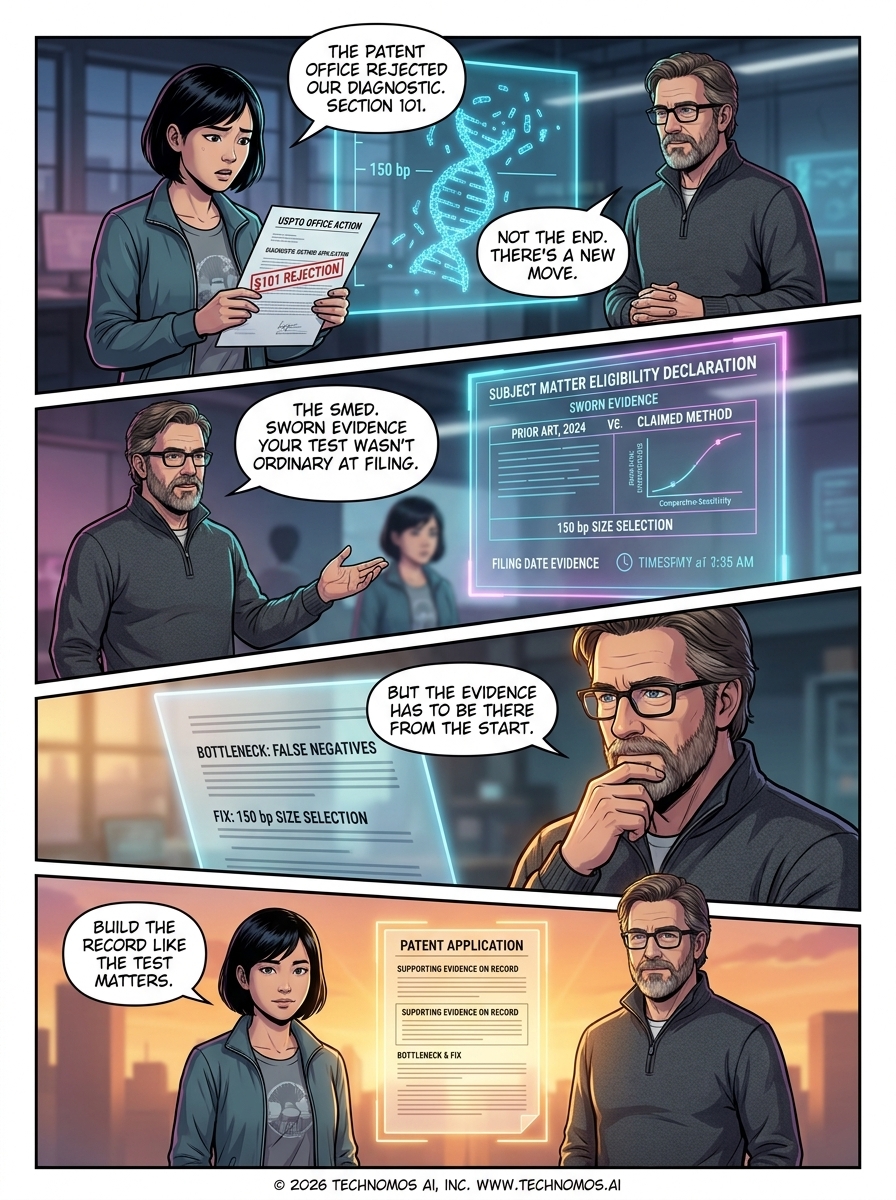
The rejection comes under Section 101. That’s the part of patent law that asks a gatekeeping question: Is this invention even in the category of stuff patents are meant to protect? For diagnostics, the Patent Office often says no. It treats the test as an unpatentable discovery about nature, not as a patentable invention.
In December 2025, the U.S. Patent and Trademark Office rolled out a new line of defense against this kind of rejection: the Subject Matter Eligibility Declaration, SMED for short. A SMED is a sworn evidentiary statement filed during patent examination to show why the claimed invention should clear the Section 101 gate. In April 2026, the Office updated its guidance and said early indications are that companies filing SMEDs are having success.
For a diagnostics company, the SMED can help turn a useful discovery into a defensible patent story: not merely “we found a biomarker,” but “we built a test competitors should not be free to copy.”
The Business Problem
Diagnostic companies often build products around an insight: a new biomarker, a determined threshold, a clinically actionable bit of information.
The business wants that insight to become an asset. Investors want to know whether competitors can copy the test. Pharma partners want to know whether the company controls something useful. Acquirers want to know whether the patents will survive diligence.
A patent claim is the legal language that defines what the patent protects. In a diagnostic case, that claim might say: take a patient sample, detect a biomarker, compare it with a threshold, and decide whether the patient has a disease.
The Patent Office response is now predictable. The examiner, the Patent Office reviewer, says the claim is really about a natural relationship: biomarker X is linked to disease Y. No company can own that natural relationship. Then the examiner says the rest of the claim is ordinary lab work: “You may have found something medically useful, but you can’t own it with a patent.”
That is the problem SMEDs are trying to solve.
Why the Declaration Matters
A fair skeptic will ask: why should another sworn statement change anything? Patent lawyers already file papers. Examiners already reject claims. A declaration does not change Supreme Court law.
True. A SMED does not rewrite Mayo, the Supreme Court case that made diagnostic patents harder to get by treating a medical-testing correlation as a law of nature.
What a SMED changes is the record. The USPTO has told examiners they must consider this evidence and explain why it does or does not overcome the rejection. And under the updated guidance, if the examiner has no evidence of their own to the contrary, that puts real pressure on the rejection. That matters because many diagnostic patent fights turn on facts.
Was the sample-preparation step ordinary when the patent application was filed? Could the data step be done in a person’s head, or did it require a real sequencing pipeline? Did the test merely observe a biomarker, or did it trigger a specific treatment decision? Did the threshold change patient care compared with standard practice?
Those are factual questions. A SMED lets the company answer them with evidence.
What a Good SMED Actually Does
A useful SMED says something like this: “At the filing date, commercial plasma assays didn’t use the claimed size-selection step to enrich the shorter, tumor-derived cell-free DNA fragments — those below about 150 base pairs — from the normal background.”
That sentence makes a difference. Cell-free DNA is DNA floating in blood plasma. Normal background fragments cluster around 166 to 167 base pairs; the fragments that carry tumor signal tend to be shorter. The sentence tells the examiner that the company was not merely observing a biomarker. It was using a specific technical step that labs were not already using in that way when the application was filed.
The Patent Office’s own examples show what makes this kind of evidence land. The strongest declarations tend to do a few things well:
– Show the test could not be done in someone’s head. When an examiner says the analysis step is just “thinking,” a SMED can show, with facts, that the data step required a real sequencing or computing pipeline, not mental math.
– Show a head-to-head improvement over what existed before. Comparative data—better sensitivity, a lower limit of detection, faster turnaround—against the standard test that was available at the filing date is some of the most persuasive evidence there is.
– Show what labs were actually doing at the time. Dated outside sources (published literature, product manuals, assay kits on the market) establish the state of the art so the examiner can see the invention was a departure from it.
– Point to exactly where the improvement shows up in the claim. The evidence has to connect to the specific words of the patent claim, not to a vague idea of the invention. The Office calls this the “nexus,” and it is where many declarations fall short.
– For a test that drives treatment, show it changes patient care. If the claim ends in a treatment decision, evidence that the decision lowers risk or improves outcomes turns that step into a real limit on the patent, not an afterthought.
For a business reader, this is the key translation: the SMED matters because it turns the patent file into evidence that the company’s test was technically different, and clinically useful, when it mattered.
Why Founders Should Start Earlier
A SMED cannot rescue a thin patent application. It cannot add missing experiments later. It cannot invent a comparison that never appeared in the original filing. The Office is explicit about this: a declaration can explain and support what the application already describes, but it cannot supply what should have been there at filing. In fact, the Office tells applicants that if they already have evidence that helps eligibility, they should put it in the application itself.
So the business lesson comes before the legal tactic: diagnostic companies should draft patent applications as if they may later need a SMED.
The application should name the bottleneck. False negatives. Poor limit of detection. Noisy plasma DNA. Slow turnaround. Weak reproducibility. A treatment decision that came too late under standard monitoring.
Then the application should describe the fix. What changed in the sample? What changed in the assay? What changed in the data workflow? What changed for the patient?
If the application tells that story, the SMED has something to point to. If it does not, the company may have a declaration with no useful exhibit behind it.
Why Investors and Partners Should Care
A diagnostic patent does not create value in a vacuum. It supports a financing story, a partner story, or an acquisition story.
At seed or Series A, the question is often whether the company controls enough of the core test to justify more clinical validation spend. In a pharma partnership, the question may be whether the diagnostic company owns the testing method tightly enough to support a companion diagnostic deal. In acquisition diligence, the question becomes even simpler: can a competitor copy the test without stepping on the patent?
A SMED does not answer all of those questions. But it can strengthen one important part of the file: why the Patent Office allowed the diagnostic claim in the first place.
That record may matter later.
The Caveat
A SMED becomes part of the patent record. A court is not bound by USPTO guidance. The person who signs the declaration may have to defend it later, under questioning, in a dispute.
So the declaration should be precise. Say what the facts support and stop there. Do not oversell. Do not turn a narrow assay improvement into a grand claim about the whole field. And leave the legal conclusion to the lawyers: the person signing should testify to facts — what the test does, what the data showed, what the field looked like at the time — not offer an opinion that the patent is “eligible.” An opinion on the legal question carries no weight anyway; the facts behind it are what persuade.
There is also a practical choice about who signs. An inventor knows the technology cold, but an independent expert with no financial stake may carry more weight, precisely because the evidence does not look self-serving.
That is a manageable risk. It is not a reason to leave the best evidence out of the file.
Use the Facts
For years, diagnostic applicants have been forced into a strange argument: “Yes, our test detects a natural biological relationship, but the patent still claims more than the relationship itself.”
The SMED gives them a better move. Show the assay. Show the sample step. Show the data. Show the treatment decision. Show what skilled people were doing when the application was filed. If the company’s value depends on the test, build the patent record like the test matters.