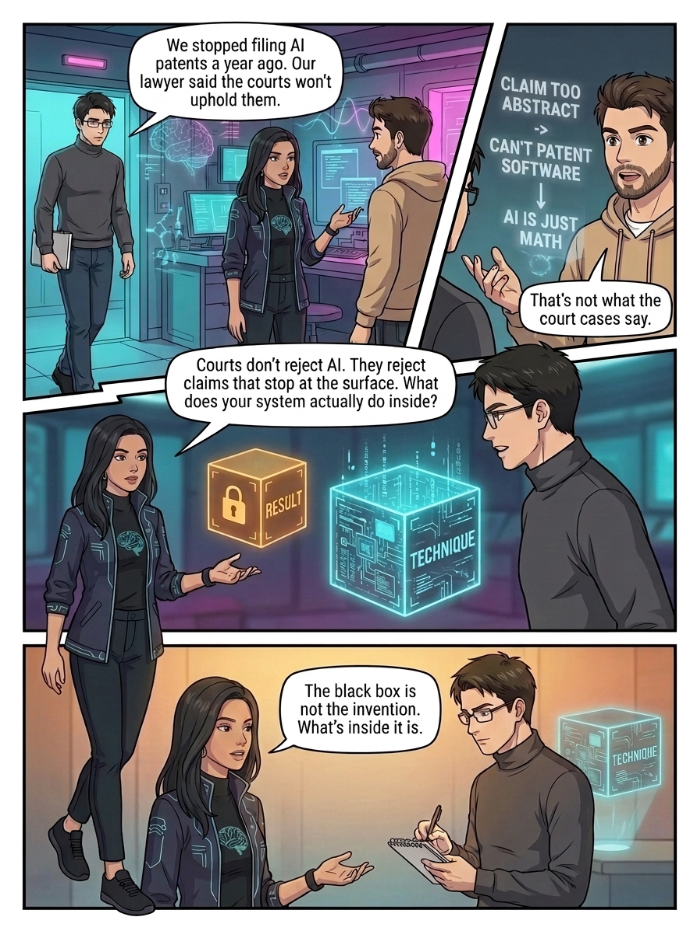
“AI isn’t patentable.” We hear this regularly from founders using AI to build new products and services.
The belief is understandable. It usually grows out of real stories. Many AI patent applications do run into trouble. But it’s not because they use AI. They often fail because the claims attempt to capture what AI accomplishes, not what the inventors actually built. “An AI that makes X faster, better, or cheaper” is usually not enough. Patent law is hostile to claims drafted at that altitude.
But in startup circles, that narrow lesson gets overread. Legal warnings flatten into shorthand. “The claim was too abstract” becomes “you can’t patent software.” “This application only claimed a business result” becomes “data analysis isn’t patentable.” “This application never explained how the system worked” collapses into “AI is just math.” Founder tells founder, and a specific drafting failure hardens into a sweeping rule: AI cannot be patented.
The Problem Is the Claim, Not the AI
That is the wrong conclusion. The problem is not AI. The problem is that the patent application fails to claim the invention with enough technical specificity: what the system does differently, how it does it, and why the difference matters.
Patent eligibility doctrine asks a threshold question. Does the claim cover the kind of thing patent law protects, or does it describe an abstract idea in technical language? The doctrine does not reject an invention simply because it uses a model, training data, inference, classification, or prediction. It asks something more akin to whether the claim stops at “use AI to get this result,” or whether it identifies the source of the technical advantage.
“We use machine learning to predict customer behavior” may describe a valuable feature. It does not yet describe the invention. A stronger patent story specifies what is new about the system and how that change improves reliability, latency, robustness, resource use, or another measure of technical performance.
Broad Claims Need a Technical Anchor
A patent is not a certificate of innovation. It is an exclusionary asset, and its value depends on what it can lawfully block. A claim as broad as applying AI to an entire industry is probably too broad if it tries to block a market result without tying that result to the technique that produced it. To block competitors effectively, a claim should identify the technical contribution that gives the system its edge.
A company can, and often should, pursue broad claims when the written application supports them. But the application should also describe and claim the technical features, for example, how the model is trained, how data moves through the pipeline, how predictions are generated or constrained, and how the AI components interact with the rest of the product.
That mix of broad and specific claims gives the application two ways to win. If the broad claim is allowed, it creates upside. If the Patent Office narrows or refuses it, the specific claims can still protect the technical features a competitor would need to replicate.
Recent judicial decisions make that distinction easier to see. Claims that treat machine learning as a black box—data goes in, a useful result comes out—are vulnerable. Claims that open the box and identify the technical contribution have a better chance of success.
Recentive: Ordinary Machine Learning Pointed at a New Business Problem
Recentive Analytics v. Fox shows one side of the line. Recentive asserted patents that used machine learning to generate schedules for live events and to build television network maps. At a high level, the claims took in event, venue, timing, program, or broadcast data, trained or updated a machine-learning model, and produced an optimized schedule or network map.
That sounds commercially useful. But the claims did not require a specific model design, a particular way of preparing inputs, a training technique, or any other technical change in how the machine-learning system worked. The Federal Circuit treated the claims as ordinary machine learning pointed at a new business problem, not as an improvement in how machine learning itself works.
The lesson should stay narrow. Recentive does not mean AI techniques are unpatentable — the court itself recognized that machine learning can produce patent-eligible advances. It means ordinary machine learning, applied to a new setting without a claimed technical improvement or specific implementation, is vulnerable.
Recentive leaves room for AI patents, but it gives little shelter to generic machine learning pointed at a business problem.
Aon: Image Inputs Tied to a Risk Estimate
Successful claims tie the AI output to something concrete inside the system. Aon Re v. Zesty.AI illustrates the point. Aon asserted patents that were not framed as a generic claim to “use AI to evaluate real estate.” The claims recited a property-risk system that used images of a property, for example aerial images, to identify property features such as roof type, roof shape, and roof condition. Those image-based features then fed a model workflow that generated an insurance risk estimate.
The claims did more than name the business result. They identified the image inputs, the property features extracted from those images, and the model workflow that connected those features to the risk estimate. When Zesty.AI challenged the patents as abstract, the court distinguished Recentive and let the case proceed, finding that the claims were tied to a specific technical implementation rather than a bare result.
VideoLabs: Tracking Objects Across Frames
VideoLabs v. Meta shows the same point in computer vision. The asserted patent, “Graphical Object Models for Detection and Tracking,” did not claim the abstract idea of analyzing video with AI. It claimed a specific method: breaking an object into parts and using both the position of those parts within a frame and their consistency across frames. That approach helped the system maintain its lock even when part of the object disappeared, blurred, or rotated.
The patent survived an eligibility challenge because the claim turned on how the system tracked objects, not on the business value of video analytics.
Desjardins: A Training Technique That Changes Model Behavior
Ex parte Desjardins gives the cleanest answer to the slogan that AI techniques are not patentable. The application addressed what machine‑learning researchers call catastrophic forgetting: training a model on a new task tends to degrade its performance on an earlier one.
The claimed technique trained the model on the tasks in sequence, but first identified which parameters mattered most to the first task, then penalized changes to those parameters during second‑task training. That let the system learn the new task without degrading performance on the first.
That is not merely an AI use case. It is a training technique, a specific way for the model to learn without forgetting. The USPTO’s leadership stepped in, convened a special review panel, and that panel vacated the Board’s new § 101 rejection—finding that the claimed training method integrates a mathematical concept into a practical application by improving how the model itself operates—while leaving the § 103 obviousness rejection in place.
The Lesson: Claim the Contribution, Not the Label
Recentive shows the risk: claiming machine learning as a tool for producing an optimized result without identifying an improvement in how the learning works. Aon, VideoLabs, and Desjardins point the other way. Each tied its claims to a specific technical contribution—image analysis in Aon, object tracking across video frames in VideoLabs, a training rule that changes how the model learns in Desjardins.
That is why claim drafting matters. A company can, and often should, pursue the broadest claims the written application supports. But it should also keep narrower claims tied to the features that create the advantage. If the broad claim survives eligibility review, the company gets the upside. If it fails, the company still holds claims to features a competitor may need to copy.
The statement “AI is not patentable” should be retired. The cases support a simpler rule: AI techniques can be protected when the claims identify a specific technical contribution. Claiming the concept of “using AI” to reach a business result cannot.