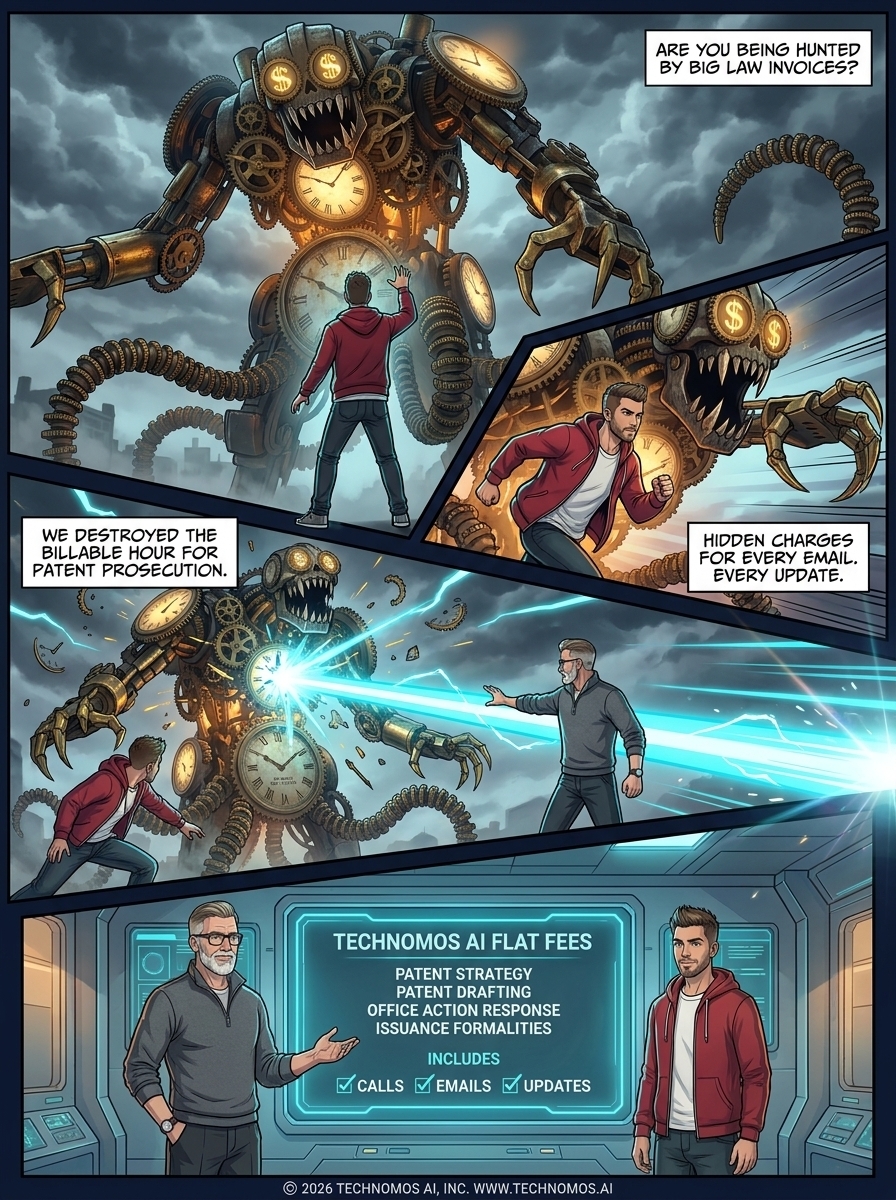
A founder reviewing her outside counsel invoices in Q3 noticed a line item she had seen before: “review of prior prosecution file in preparation for response drafting, 3.4 hours.” She had paid for that line item, or something equivalent, on four separate matters in the past eighteen months. Four attorneys. Four separate reconstructions of context the firm had built and stored and never structured to reuse. She had not noticed it as a pattern. It had appeared, four times, as the ordinary cost of legal work. The pattern she found is the pattern we built TechNomos to fix.
This is what the billable hour also does. Not just price time. Transfer cost. Specifically, the cost of inefficiencies the firm could have built systems to eliminate but didn’t. When the partner reviews a draft AI could have flagged five problems with in thirty seconds, that review is on the invoice. When the meeting needs four attorneys because no one holds the full portfolio context, the bill is for the structural failure that made them all necessary. None of it appears on the invoice as waste. It appears as work.
What AI actually changed
AI breaks this. Not because AI replaces attorneys, but because AI makes the gap visible. The hour was always an imperfect proxy for value; the gap was hidden when the inputs to legal work were uniformly slow. When digging for relevant prior art that took four hours can be done in thirty minutes, the four-hour line item no longer measures what the work actually requires. When a first-pass office action response that took a day of drafting can be generated in an afternoon, the eight-hour bill is no longer the cost of producing the response. It is the cost of producing it the slow way.
There is a principle behind which tasks AI affects and which it doesn’t. Paul McDonagh-Smith at MIT Sloan describes it as a shift in the capability landscape. AI has made some skills abundant and cheap, while others have become harder to replace and remain in demand, so their value has risen. He calls the cheapened side FADE: familiar pattern recognition, assembling information, doing procedures, encyclopedic memory. He calls the appreciating side RISE: reasoning under uncertainty, imagination, social trust, sensemaking.
Patent prosecution runs on both. Screening prior art, drafting shell response documents, surfacing examiner patterns across a docket, generating first-pass response strategies: FADE, all of it. Deciding whether to appeal, choosing which claim scope to surrender, reading an examiner well enough to know whether an interview moves the needle, advising on continuations to preserve options for the next product cycle: RISE, all of it. The bill draws no distinction. A billable hour of judgment and a billable hour of cite-checking enter the invoice as the same line item.
On FADE work, the bill no longer matches the work. AI sets the benchmark for what the work actually requires, whether or not the firm has built AI into the workflow. RISE work still takes the time it takes. Reading an examiner is still reading. Advising a client on a continuation strategy is still advising. The inputs have changed for some of the work. The pricing model has not changed for any of it.
Why most firms haven’t fixed it
The reason most firms have not fixed this is that hourly billing pays them not to. Under an hourly bill, an hour saved by automation is revenue lost. A firm that builds the systems to dig through prior art in thirty minutes instead of four hours is collapsing its own top line. Until the billing structure changes, the work has no reason to.
So the typical firm has not built AI in where it would save time, and the bill matches the hours actually spent doing the work the slow way. The exception is the firm that has built AI in and is keeping the bill where it was, banking the savings as margin. Both versions transfer the same cost to the client.
Why a flat fee alone isn’t the answer
The question is what replaces the hour. Not “flat fees” alone. A flat fee on a practice that has not built the underlying systems just changes who absorbs the waste, not whether the waste exists. What the client should be paying for is not a different number on the invoice. It is a different practice underneath it.
What we built TechNomos to be
This is what we have built TechNomos to be. Prior-art analysis structured as reusable input, so the fifth matter in a technology area enters with four matters’ worth of context rather than rebuilding from scratch. Examiner intelligence captured in queryable form. Prosecution reasoning preserved so a different attorney can use it directly, without the two-day file review that has appeared, four times, on four invoices. The flat fee is funded by the efficiency the systems create. The client pays for the judgment. The reconstruction cost is gone because the reconstruction was eliminated, not buried in the rate.
We have built TechNomos to treat AI as a component of a system, not as a faster version of the old tools and not as a capability we have chosen to leave unbuilt. AI handles the FADE work: retrieval, pattern detection, first-pass drafting. The attorney handles the RISE work: reasoning through what the prior art means for this claim, the synthesis behind a claim strategy that holds up across product generations, counseling a founder through a contested rejection, sensemaking across a year of prosecution history. The fee reflects what the client is actually buying: the strength of the claim position, the durability of the portfolio, the defensibility of the prosecution record. Not the hours it took to produce them.
A pricing model that charged the same rate for FADE work and RISE work was always running on a category mistake, and the buyer was paying for it. AI made the mistake legible.
This is why we did not wait. TechNomos is built for a market in which clients price legal services the way they already price most other professional services: by what they get, not by how long it took.
The hour was a useful proxy when producing legal work required the same inputs every time. It was not designed for a world in which the fifth iteration of a task can be done in a fraction of the time of the first because all four prior iterations have been structured as reusable input.
That world is here. The billing model that made sense in the other one is still on the invoice.